
What your 9 water readings mean (and what they don’t)
October 15, 2026 · 5 min read
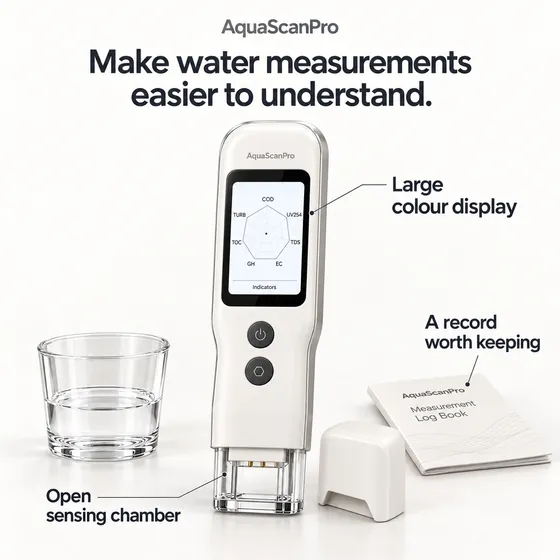
AquaScanPro has 9 detection modes. Each reading is an indicator. Each one describes a general property of the sample. None of them, alone or together, tells you whether water is safe, and none of them identifies a specific contaminant. For safety questions, use a certified laboratory.
Dissolved minerals: TDS and EC
TDS (total dissolved solids) is an estimate of everything dissolved in the water, mostly minerals and salts such as calcium, magnesium and sodium. It's handy for comparing water before and after a filter, or between two sources. A low TDS doesn't mean "clean", and a high TDS doesn't mean "dirty".
EC (electrical conductivity) is how easily the water carries an electrical current. It rises with dissolved ions, and it's the raw signal many TDS readings are based on. It says nothing about substances that don't carry a charge, like most organic compounds.
Salts and temperature: SALT and TEMP
Salinity is the total concentration of dissolved salts, shown as a percentage. It's most useful for aquariums and brackish sources, and for spotting a change from your usual baseline. It doesn't tell you which salts are present.
Temperature is the temperature of the sample when you measure it. On its own it says nothing about water quality, but it affects conductivity-based readings, so noting it helps you compare sessions fairly.
Hardness: GH
GH (general hardness) is the amount of dissolved calcium and magnesium. Hard water is linked to limescale on kettles, faucets and showerheads, and to spotting on glassware. It tells you nothing about other dissolved substances.
Cloudiness: turbidity
Turbidity is how cloudy or hazy the water is, based on how suspended particles scatter light. It can show changes in sediment, silt or rust, including haze too faint to see by eye. It can't tell you what the particles are, or whether microorganisms are present.
Organic matter: TOC, COD and UV254
- TOC (total organic carbon) is a broad indicator of how much organic material is present, from soil, leaves or other natural and man-made sources.
- COD (chemical oxygen demand) reflects how much oxygen would be needed to chemically break down the material in the sample. Higher generally means more material.
- UV254 is how much ultraviolet light at 254 nanometers the sample absorbs. Many naturally occurring organic substances absorb at this wavelength, so it's widely used as a general indicator of dissolved organic matter.
None of the three tells you which compounds are present, or whether any of them matter for health.
The overall grade
After each test the meter also shows an overall grade from A to D. It's a quick summary of the same indicator readings, not a safety rating or a lab result.
How to use them
Take your first readings as a baseline, log the source and conditions, and re-test the same way. The useful signal is change against your own baseline, not a single number.